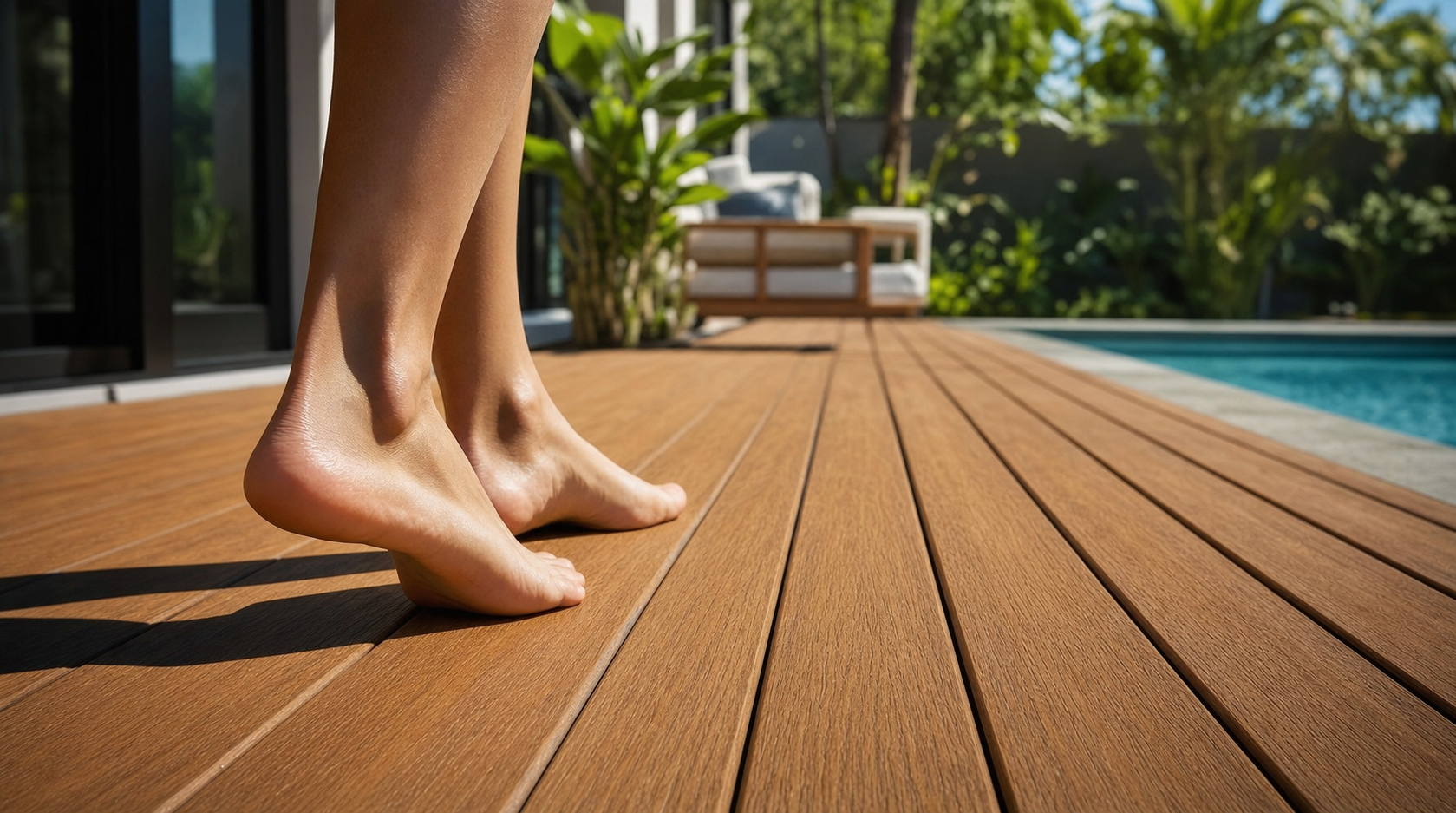
Everyone knows the move. It's the first hot Saturday of the summer, the deck has been baking since ten in the morning, and somebody walks out barefoot for thirty seconds before doing the hot-coal dance back to the door. On the wrong deck, that's the whole season. The surface gets hot enough that nobody actually uses the thing between noon and five.
A deck surface temperature problem is a material problem. The sun does the same thing to every board. What changes is how the board handles the energy it absorbs. This is the explainer for why color, capstock, and core all decide whether your deck is a place to stand or a griddle, and what we engineered into TrueGrain Deck™ to keep it on the right side of that line.
What actually heats a deck
A deck board sitting in direct sun is doing three things with solar energy at the same time. It reflects some of it, it absorbs some of it, and it re-radiates some of it back as heat. The fraction it absorbs is what you feel through the soles of your feet. Three variables drive that number:
- Color. This is the big one. Dark surfaces absorb far more of the visible spectrum than light ones. A deep espresso board and a pale driftwood board can sit side by side in the same sun and feel like two different planets.
- Surface chemistry. Two boards can read as the same color to your eye and still absorb different amounts of solar energy, because some of the sun's energy is in the near-infrared range you can't see. A cap engineered to reflect more of that invisible portion runs cooler than a color swatch alone would predict.
- How fast heat moves through the board. A material that holds heat at the surface feels hotter underfoot than one that lets it spread. Density and cell structure both play into this.
Put those together and you get the rule of thumb every deck owner learns the hard way. Darker is hotter, sunnier is hotter, and the material under the color decides how much worse it gets.
The sun hits every deck the same. The board decides what you feel.
Where wood and uncapped composites lose
Natural wood and a lot of early composite decking share the same weakness in summer. They were never engineered for the infrared part of the problem. Color was chosen to look like a hardwood, and the heat performance was whatever the pigment happened to deliver. On a dark composite in full afternoon sun, that often means a surface too hot for comfortable bare feet for hours at a stretch.
There's a second trap. Many boards that try to solve heat by going pale also fade, chalk, or stain over a few seasons, so the "cool" light color you bought slowly becomes a different, dirtier color you didn't. Solving heat without solving fade is only half a deck.
How TrueGrain Deck™ is built to run cooler
TrueGrain is a capped cellular PVC board, and every layer in the stack is doing a job. From the top down, a decorative wood-grain foil is laminated to a weatherable ASA capstock, which is bonded over a moisture-resistant cellular PVC core. The construction is what gives us room to engineer heat and looks at the same time, instead of trading one for the other.
- The ASA cap reflects more of the solar spectrum. The capstock is formulated to bounce back a larger portion of the sun's energy, including part of the range your eye can't see, so the board runs measurably cooler under direct sun than its color alone would suggest.
- The cellular PVC core spreads heat instead of stacking it. The foamed, closed-cell core doesn't behave like a solid dark slab holding a hot skin at the top.
- The wood-grain colors are designed in, not painted on. Because the look comes from a laminated decorative layer protected by the weatherable cap, you get rich hardwood tones that hold up, not a pale compromise color chosen only to dodge the heat.
The practical result is the one that matters on a July afternoon. TrueGrain is engineered to be cool enough to walk on barefoot, even in a warm walnut tone, which is exactly the color most people are scared to pick on a hot deck.
How to pick for heat without giving up the look
If summer comfort is high on your list, you don't have to settle for a beige deck. A few moves stack the deck in your favor:
- Lean a shade lighter in full-sun spots. Pool decks, south-facing patios, and unshaded rooftops are where color choice pays off most. The lighter end of the TrueGrain range will always feel coolest.
- Use the cap, not just the color. A TrueGrain board in a mid-tone runs cooler than an uncapped dark board in the same shade, because the ASA cap is doing work the pigment can't.
- Order samples and leave them in the sun. The most honest heat test in the world is free. Set your top two or three colors out at noon and touch them after an hour. We'll ship the boards so you can.
A deck is supposed to be the part of the house you actually live on all summer. Heat is the thing that quietly steals those hours, and it's a thing you get to decide at spec time, before the first board ships. Pick the construction that was engineered for the sun, and July stays barefoot.