
How to install
PVC porch flooring.
American Pro tongue-and-groove cellular PVC porch flooring installs the same way wood porch flooring has for a century, with the tools your installer already owns. Here is the step-by-step, from framing and slope through fastening and the final board.
To install PVC porch flooring, joist spacing depends on board thickness: 3/4 inch porch flooring is rated for joists spaced up to 12 inches on center, and 1 inch nominal (7/8 inch actual) porch flooring is rated for joists spaced up to 16 inches on center. Slope the joists 1/4 inch per foot away from the structure. Start with the groove side against the structure, face-fasten the first board near the structure, then drive a fastener through the tongue at each joist at a 30 to 45 degree angle. Slide each following board's groove over the previous tongue, keep the top gap consistent, and rip the final board to width.
American Pro porch boards use the same tools and fastening pattern as wood porch products, so no proprietary manual or tooling is required. The full step-by-step is below.
Tools and
fasteners.
Porch board installs with the same tools used for wood porch products. There is no special tooling to buy and nothing proprietary to learn.
Tools
- Pneumatic or electric screw gun
- Pneumatic or electric nail gun
- Circular or miter saw for cutting to length
- The standard tools used for wood porch flooring
Fasteners
- Trim head screws or serrated nails
- Minimum #7 × 2" 305 stainless steel trim head screws with a #17 drill point
- Or minimum 2" barbed or serrated steel cleat "T" nails or "L" cleats
Installing the
porch floor.
Six steps from framing to the final board. Each board end must be supported by a joist, so plan your framing before you start laying boards.
Frame the joists to match your board thickness
Joist spacing depends on which American Pro porch flooring thickness you're installing: 3/4 inch porch flooring is rated for joists spaced a maximum of 12 inches center to center, and 1 inch nominal (7/8 inch actual) porch flooring is rated for joists spaced a maximum of 16 inches center to center. Make sure the end of each board is supported by a joist.
Two thicknesses. Pick by joist spacing.
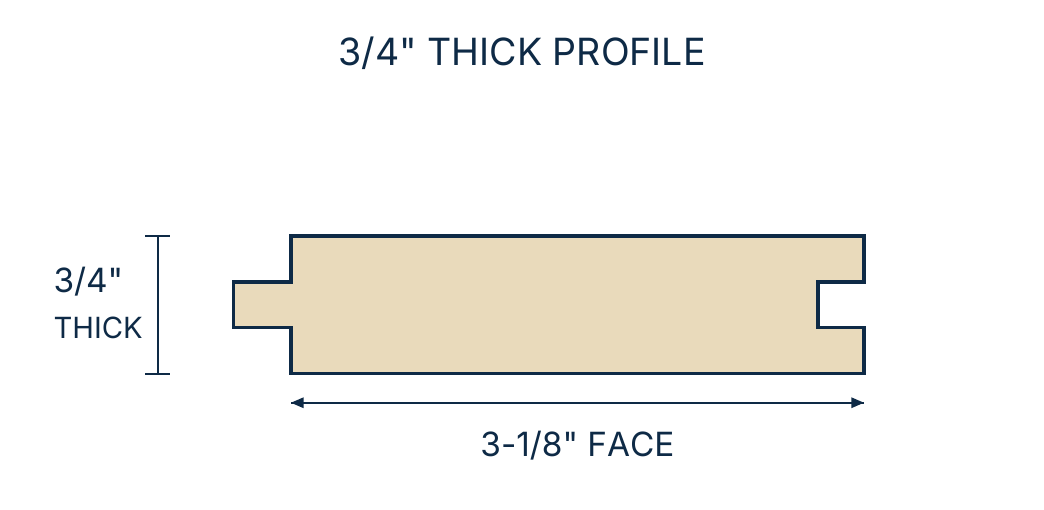
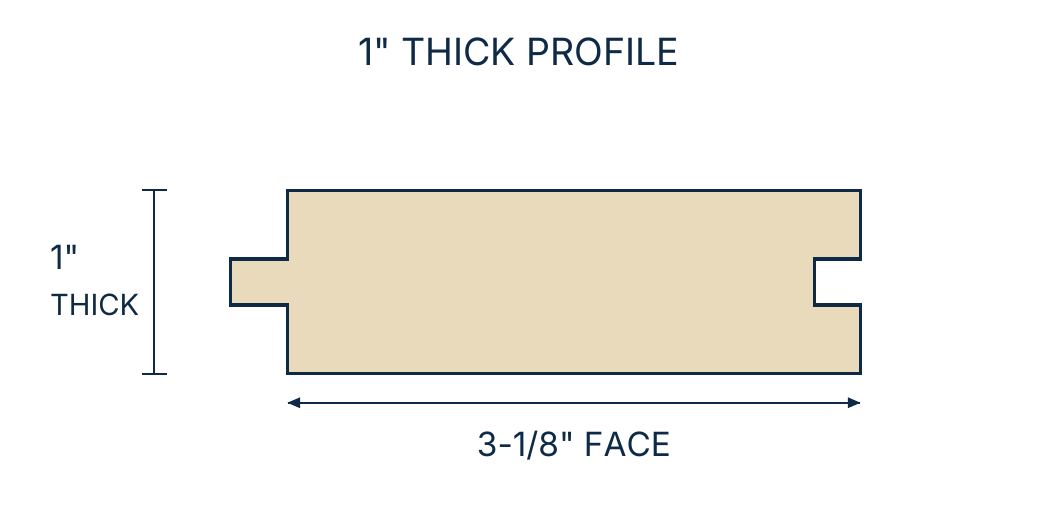
1" is the nominal size; the board measures 7/8" actual. Profiles are schematic.
Slope the joists away from the structure
Ideally, slope the joists away from the structure at 1/4 inch per foot so water sheds off the porch instead of pooling against the house.
Choose tools and fasteners
Use the same tools used for wood porch products: a pneumatic or electric nail gun or screw gun. Fasten with either trim head screws or serrated nails. Use minimum #7 × 2" 305 stainless steel trim head screws with a #17 drill point, or minimum 2" barbed or serrated steel cleat "T" nails or "L" cleats.
Set and fasten the first board
Begin with the groove side of the planks against the structure, or at the outside edge of the porch if boards run perpendicular to the structure. Drive one fastener through the face of the board into the joist as close to the structure as possible.
Then attach at each joist by driving a fastener through the tongue at a 30 to 45 degree angle. Countersink screws so they seat about 1/16 inch into the product, leaving room to insert the next board.
Interlock and continue the field boards
Insert the grooved edge of the next board over the exposed tongue. Adjust the top gap between the boards to the desired look and keep it consistent throughout the installation.
Attach at each joist through the tongue as before, and repeat until you reach the edge of the porch.
Finish the last board and the joints
The final board may require removing the tongue or a rip cut to the desired width. Keep end butts and miters tight, and install boards as soon as possible after cutting to avoid temperature changes.
Installed properly, American Pro PVC porch flooring sees minimal expansion and contraction. If you must install below 32°F, which is not recommended, leave a 1/16 inch gap, and avoid installation at high temperatures.
A note on care. Once installed, American Pro PVC porch flooring cleans with soap and water and never needs sanding, staining, or sealing. Because it is cellular PVC with no exposed wood fiber, it will not rot or splinter over time.
New to PVC porch flooring? See the full PVC porch flooring buying guide, compare PVC vs wood vs composite, or order free board samples to see the colors on your own home first.
Installing porch
flooring.
The installation questions homeowners and builders ask most, answered straight from the install spec.
How do you install PVC porch flooring?
Install tongue-and-groove cellular PVC porch flooring on joists sloped 1/4 inch per foot away from the structure, with joist spacing sized to the board thickness. Start with the groove side against the structure, face-fasten the first board near the structure, then drive a fastener through the tongue at each joist at a 30 to 45 degree angle. Interlock each following board's groove over the previous tongue, keep the top gap consistent, and rip the final board to width. Use the same tools as wood porch products.
What joist spacing does PVC porch flooring need?
Joist spacing depends on board thickness. American Pro's 3/4 inch porch flooring is rated for joists spaced a maximum of 12 inches center to center, and the 1 inch nominal (7/8 inch actual) porch flooring is rated for joists spaced a maximum of 16 inches center to center. Each board end should be supported by a joist, and the joists should ideally be sloped away from the structure at 1/4 inch per foot so water drains off the porch.
What screws or fasteners are used for PVC porch flooring?
Fasten American Pro PVC porch flooring with either trim head screws or serrated nails. Use minimum #7 x 2 inch 305 stainless steel trim head screws with a #17 drill point, or minimum 2 inch barbed or serrated steel cleat "T" nails or "L" cleats. Drive most fasteners through the tongue at a 30 to 45 degree angle and countersink them so they seat about 1/16 inch into the board.
What tools do I need to install PVC porch flooring?
You can install American Pro PVC porch flooring with the same tools used for wood porch products: a pneumatic or electric nail gun or screw gun for fastening and a saw for cutting boards to length and ripping the final board. No special manual or proprietary tooling is required.
Do you need an expansion gap when installing PVC porch flooring?
American Pro PVC porch flooring experiences minimal expansion and contraction when installed properly, so end butts and miters should be kept tight. Install boards as soon as possible after cutting to avoid temperature changes. If you must install below 32 degrees F, which is not recommended, leave a 1/16 inch gap, and avoid installing at high temperatures.
Which way does the tongue and groove face when installing porch flooring?
Begin installation with the groove side of the planks against the structure, or at the outside edge of the porch if the boards run perpendicular to the structure. Each following board's grooved edge slides over the previously installed board's exposed tongue, and you fasten through that tongue into the joist.