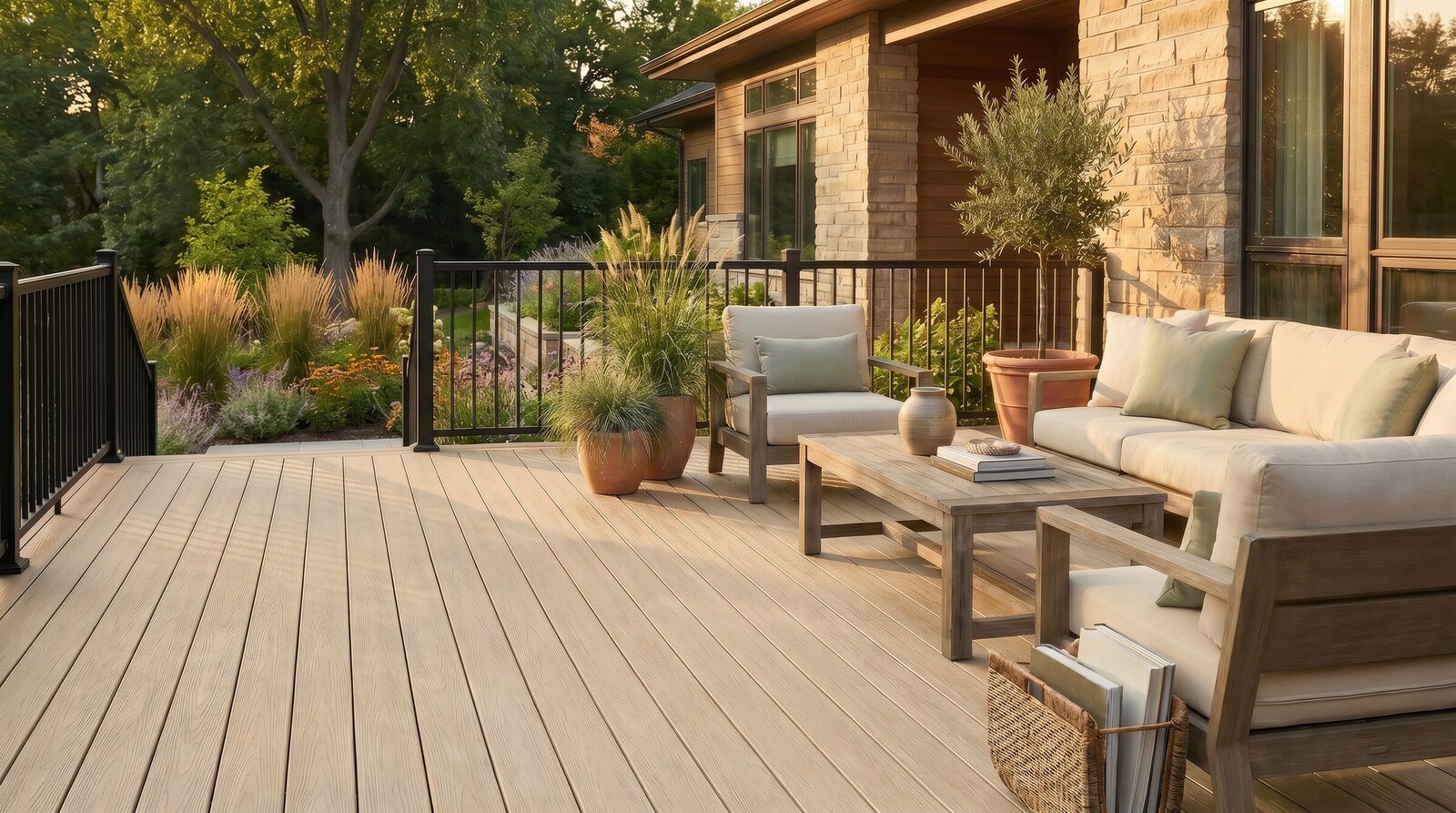
What is cellular
PVC decking?
New to the term? Cellular PVC decking is a deck board made from foamed PVC with no wood fiber, which is why it won't rot, swell, or splinter. Here's a plain-English guide to how it's made, how it compares to composite, and whether it's worth the premium.
Cellular PVC decking is a deck board made from polyvinyl chloride with a closed-cell foamed structure and no wood fiber. The foamed core keeps it lighter and easier to work than solid PVC while staying stiff and strong, and because there is no wood content, water has no path into the board. That is why it won't rot, swell, or splinter.
American Pro makes two cellular PVC lines: TrueGrain Deck (capped, with a laminated hardwood-grain surface) and Legacy PVC Decking (solid-color with a subtle grain). Both are extruded by Patwin Plastics in Linden, NJ, and carry a 25-year limited residential warranty.
Cellular PVC vs
the alternatives.
Short answer: cellular PVC trades a higher upfront price for the lowest long-term maintenance and the best moisture immunity.
| What matters | TrueGrain PVC | Capped Composite | Traditional Wood | Other Premium PVC |
|---|---|---|---|---|
| Warranty | 25-yr limited residential surface, 10-yr commercial | Long limited terms; fade coverage varies widely | None beyond lumber grade | Comparable long limited warranties |
| Material composition | Foamed cellular PVC core, ASA cap, no wood fiber | Wood-fiber core under a polymer cap | Solid natural wood | Cellular or solid PVC, no wood fiber |
| Heat resistance | Cool-deck formulation, cooler than dark composite | Can run hot in dark colors and direct sun | Moderate, but greys and slick when wet | Generally cooler than composite; varies by cap |
| Surface texture | Laminated grain (TrueGrain) or subtle grain (Legacy) | Embossed grain, can read repetitive | Real grain, but splinters and checks | Embossed or printed grain, varies by line |
| Price tier | Premium | Mid to premium | Low upfront, high upkeep | Premium |
| Maintenance | Soap & water, never sand, stain, or seal | Occasional cleaning; can stain or fade early | Sand, stain & seal regularly | Soap & water |
How cellular PVC
actually works.
Short answer: it's foamed PVC, extruded to a controlled density, often capped and finished with a wood-grain surface.
How it's made
PVC compound is foamed to a controlled closed-cell density and pushed through a die that forms the board profile, a process called extrusion. Premium boards are capped, meaning a weatherable ASA layer is co-extruded over the core, and some add a laminated wood-grain surface on top. American Pro's boards are extruded by Patwin Plastics, which mixes its own compound and cuts its own tooling in Linden, NJ.
Verdict: extruded, foamed, capped, and finished, on one domestic line.
Why no wood fiber matters
Composite still contains wood flour or fiber, which can absorb moisture, swell, stain, and fade. Cellular PVC has none, so there is no moisture path anywhere, including at cut ends and fastener holes. That is the single biggest reason it resists rot, swelling, and staining better than composite or wood.
Verdict: no wood fiber, no moisture path, no rot.
Heat, color, and upkeep
Any deck warms in the sun, and dark colors run warmer than light ones. Cellular PVC with a reflective cap generally stays cooler than dark composite. Day to day, it cleans with soap and water and never needs the sanding, staining, or sealing that wood demands.
Verdict: cooler than dark composite, and close to zero upkeep.
Ready to go deeper? Compare PVC vs composite decking, read the premium PVC buyer's guide, or see the most realistic wood-look PVC decking.
Cellular PVC,
done properly.
Short answer: TrueGrain shows what cellular PVC can be when one company controls the compound, the core, the cap, and the finish.
Vertically integrated, made in the USA
Patwin Plastics mixes its own PVC compound, extrudes the cellular core, co-extrudes a proprietary ASA cap, and laminates the wood-grain film, all in Linden, NJ, with 50 years of extrusion experience. That control keeps cell density and the cap-to-core bond consistent across every board and color.
One facility, one chemistry, from compound to cap.
Two finishes on the same core
Choose TrueGrain Deck for a laminated, photoreal hardwood grain in six colors including Royal IPE, or Legacy PVC Decking for a solid-color classic with a subtle grain. Both are cool underfoot and come in three profiles: Solid Edge, Grooved Edge, and Grooved for InvisiClip.
Pick the look; the durability comes standard.
See cellular PVC for yourself.
Order free 6-inch samples to feel the board and read the grain, or drop a color onto a photo of your deck in the 3D Deck Builder to see how it looks at home.
Cellular PVC,
explained.
The questions first-time deck shoppers ask most about cellular PVC.
What is cellular PVC decking?
Cellular PVC decking is a deck board made from polyvinyl chloride with a closed-cell foamed structure, which makes it lighter and easier to work than solid PVC while staying stiff and strong. Because it contains no wood fiber, water has no path into the board, so cellular PVC won't rot, swell, or splinter. Premium versions add a weatherable cap and a wood-grain surface.
What is the difference between cellular PVC and composite decking?
Composite decking blends wood flour or fiber with plastic, so it still contains wood content that can absorb moisture, swell, stain, and fade. Cellular PVC has no wood fiber at all, so there is no moisture path anywhere in the board, including at cut ends and fastener holes. Cellular PVC also tends to run cooler underfoot than dark composite when it uses a reflective cap.
How is cellular PVC decking made?
Cellular PVC decking is extruded: PVC compound is foamed to a controlled closed-cell density and pushed through a die that forms the board profile. Premium boards are capped, meaning a weatherable ASA layer is co-extruded over the core, and some, like TrueGrain, add a laminated wood-grain surface. American Pro's boards are extruded by Patwin Plastics in Linden, NJ.
Does cellular PVC decking get hot?
Any decking warms in direct sun, and darker colors always run warmer than lighter ones. Cellular PVC with a reflective cap generally stays cooler than dark composite. TrueGrain Deck uses a cool-deck formulation that reflects more solar energy than dark composite, so lighter colorways stay more comfortable through the hottest part of the afternoon.
Is cellular PVC decking worth it?
For homeowners who want the lowest long-term maintenance, cellular PVC is worth the premium. It never needs sanding, staining, or sealing, won't rot or splinter, and resists the moisture damage that shortens a wood or composite deck's life. American Pro cellular PVC carries a 25-year limited residential warranty and cleans with just soap and water.