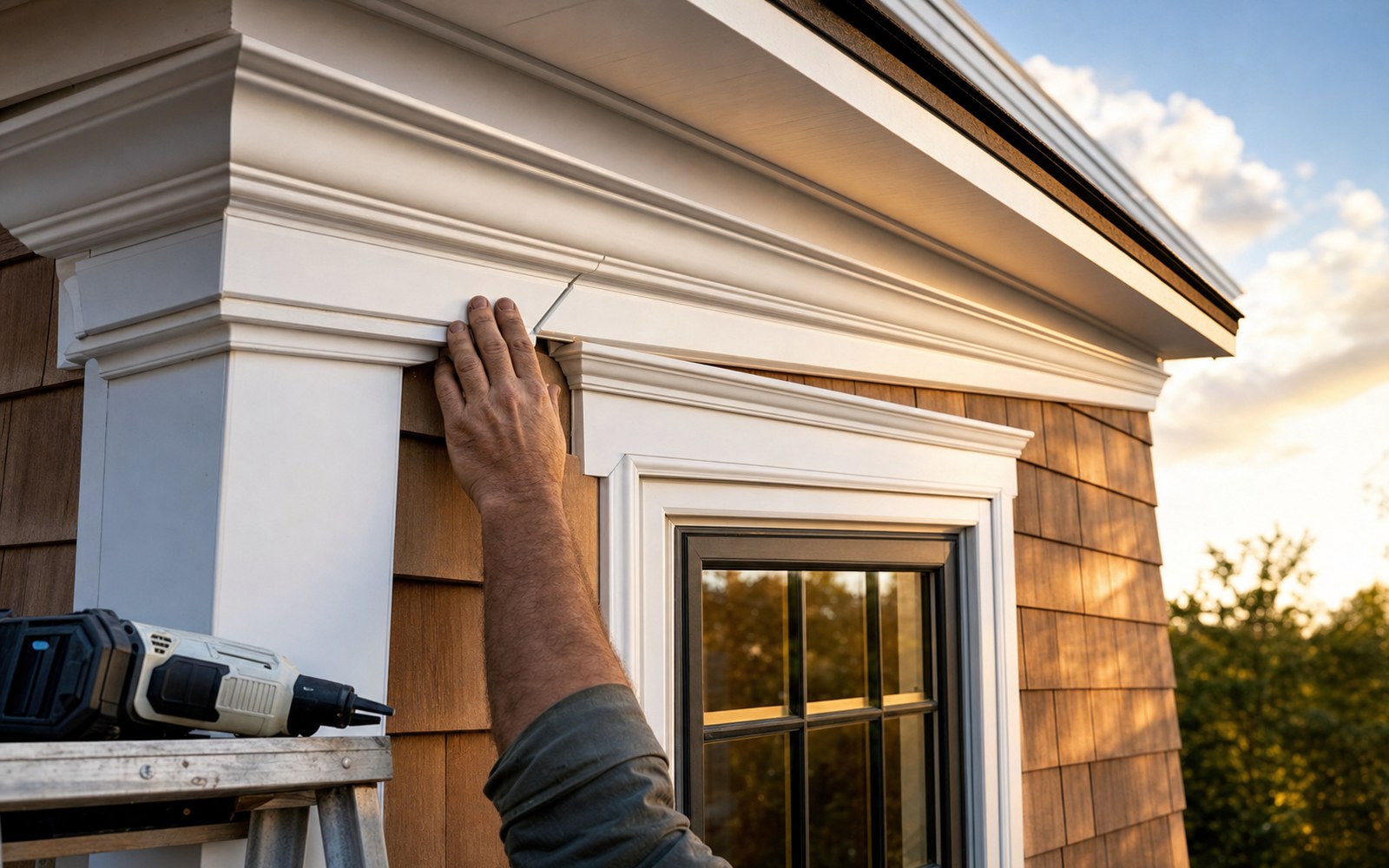
Crown moulding is the trim that sets the scale of a house before anyone consciously notices it. Too small under a deep overhang and the roofline looks unfinished. Too large on a modest single story and the house looks like it is wearing someone else's coat. Getting it right is not about picking a favorite profile from a catalog page. It is arithmetic: eave depth, wall height, and how far back you stand to look at it.
American Pro cuts PVC crown in five standard sizes plus three specialty crown profiles, all extruded in-house at Patwin Plastics in Linden, New Jersey. Here is how to read your own roofline and land on the right one, plus how casing, brick mould, and sill tie into the same decision.
Start with the overhang, not the room
Interior crown gets sized to ceiling height. Exterior crown gets sized to the depth of the eave and fascia it sits under, and to how far the wall it wraps sits from the street or the walkway. A crown that looks correct tucked under a 6 inch fascia on a one-story cottage will look thin and lost under a 10 inch overhang on a two-story colonial with tall first-floor windows. The house tells you the size before the spec sheet does.
Those are starting points, not rules. A 4 5/8 inch crown on a small farmhouse porch can look correct if the porch has tall square columns and a deep frieze board above them. The same crown on a low ranch with a narrow fascia will look oversized. Stand where a visitor stands, at the front walk or the curb, and judge scale from there rather than up close on a ladder.
The full standard catalog, not just crown
Crown gets the attention, but it rarely works alone. The Standard catalog covers the trim families specified most often on a real house: five crown sizes, Solid Crown, Rams Crown, Rake Mold, Adam's Casing, Heavy Sill, Historic Sill, Drip Cap, Brick Mould, J-Brick, Back Band, Bed Mould, Bead Cap, Base Cap, Quarter Round, Scotia Cove, and Shingle moulding. Each one is extruded from the same cellular PVC, so a casing and a crown ordered together age and paint identically, with no seam between a wood piece and a PVC piece the way you get when trim gets pieced together from two different materials over the years.
The Special catalog exists for the profiles that solve one specific problem rather than showing up on every job: Cove, Water Table Silo, 1.25 inch Square stock, a 7 inch Large Cove, two sill nose profiles, and balluster stock in 1.25 and 1.50 inch. Several of these ship by request rather than sitting on a shelf, because they get specified less often but need to match exactly when they do, usually on a historic restoration or a custom porch rail.
When one profile is not enough
The biggest sizing mistake is treating crown as a single piece that has to do everything. On a portico, an entry surround, or a gable return that needs real visual weight, a two-piece build-up, typically a crown profile run over a bed mould, reads larger and casts a deeper shadow line than jumping to the next crown size alone. It also lets you keep a mid-size crown on the main roofline for cost and proportion, then reserve the built-up detail for the one or two places on the house meant to draw the eye, the front door surround or a projecting bay.
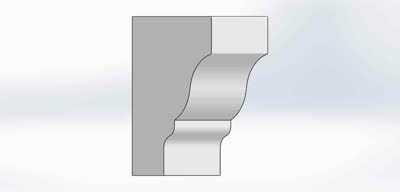
Rams Crown and Solid Crown exist for exactly this middle ground. Both read heavier than the numbered crown sizes at a similar footprint, which makes them a way to add weight to an entry or a dormer without going all the way to an 8 inch crown that might overwhelm the rest of the house.
Casing, brick mould, and sill follow the same logic
Once the crown is settled, the window and door trim around it should scale with it, not compete with it. A heavy crown paired with thin, narrow casing looks unfinished for the same reason a big house with a tiny front door looks wrong. Adam's Casing is the standard window and door casing profile in the catalog, sized to read correctly next to 3 5/8 inch and 4 5/8 inch crown on most homes.
Brick mould and J-Brick handle the transition where a window or door frame meets masonry or siding, and they come in the same white cellular PVC as the crown, so a full trim package, crown, casing, brick mould, sill, and base cap, ages as one material rather than as four different materials weathering at four different rates. Heavy Sill and Historic Sill add the sloped, water-shedding detail under a window, sized to project past the casing enough to actually throw water clear of the wall below it.
Fastening, painting, and thermal movement
PVC crown installs with standard stainless trim screws or hot-dipped galvanized finish nails, the same tools already on a trim crew's belt. Scarf joints on long runs get glued with PVC cement for a seam that will not open the way a butted wood joint does. Every profile ships primed white and takes 100 percent acrylic exterior paint in any color, but light colors are the better call on long horizontal runs. Dark paint absorbs more heat, and more heat means more thermal expansion along the length of the piece, which matters most on an 8 inch crown running the full width of a gable.
None of this changes the core reason PVC crown gets specified over wood in the first place. Cellular PVC does not rot, split, or wick moisture, so a crown detail sitting directly under a leaking gutter or exposed to years of runoff holds its profile instead of softening at the top edge the way a wood crown eventually does. The full case for why PVC trim outlasts wood covers that side of the decision if durability, not sizing, is the open question.
A quick decision table
| House type | Crown size | Casing | Notes |
|---|---|---|---|
| Cottage, bungalow | 2 3/4" or 3 5/8" | Adam's Casing | Shallow eaves read best with a lighter shadow line. |
| Ranch, ranch-style addition | 3 5/8" | Adam's Casing | Long horizontal rooflines favor a modest, consistent size over one large piece. |
| Colonial, two story | 4 5/8" | Adam's Casing + Back Band | The most common size across the catalog for this house type. |
| Craftsman, deep eaves | 4 5/8" or 5 1/4" | Adam's Casing | Pair with Rake Mold along the gable for a matched rake and eave line. |
| Portico, formal entry | 5 1/4" to 8", or built-up crown + Bed Mould | Adam's Casing + Brick Mould | The one spot on the house where going larger than the rest is usually correct. |
| Historic restoration | Match existing, or custom-tooled | Historic Sill, Drip Cap | Send a cut section from the original profile for a matched custom die. |
If the house does not fit neatly into one of those rows, that is normal. Order a hand sample of the size that looks closest on paper, hold it against the fascia or the window casing you are replacing, and step back to the street. The crown either disappears into the roofline the way it should, or it announces itself as too small or too heavy. That fifteen minutes with a sample in hand settles more sizing debates than any chart.