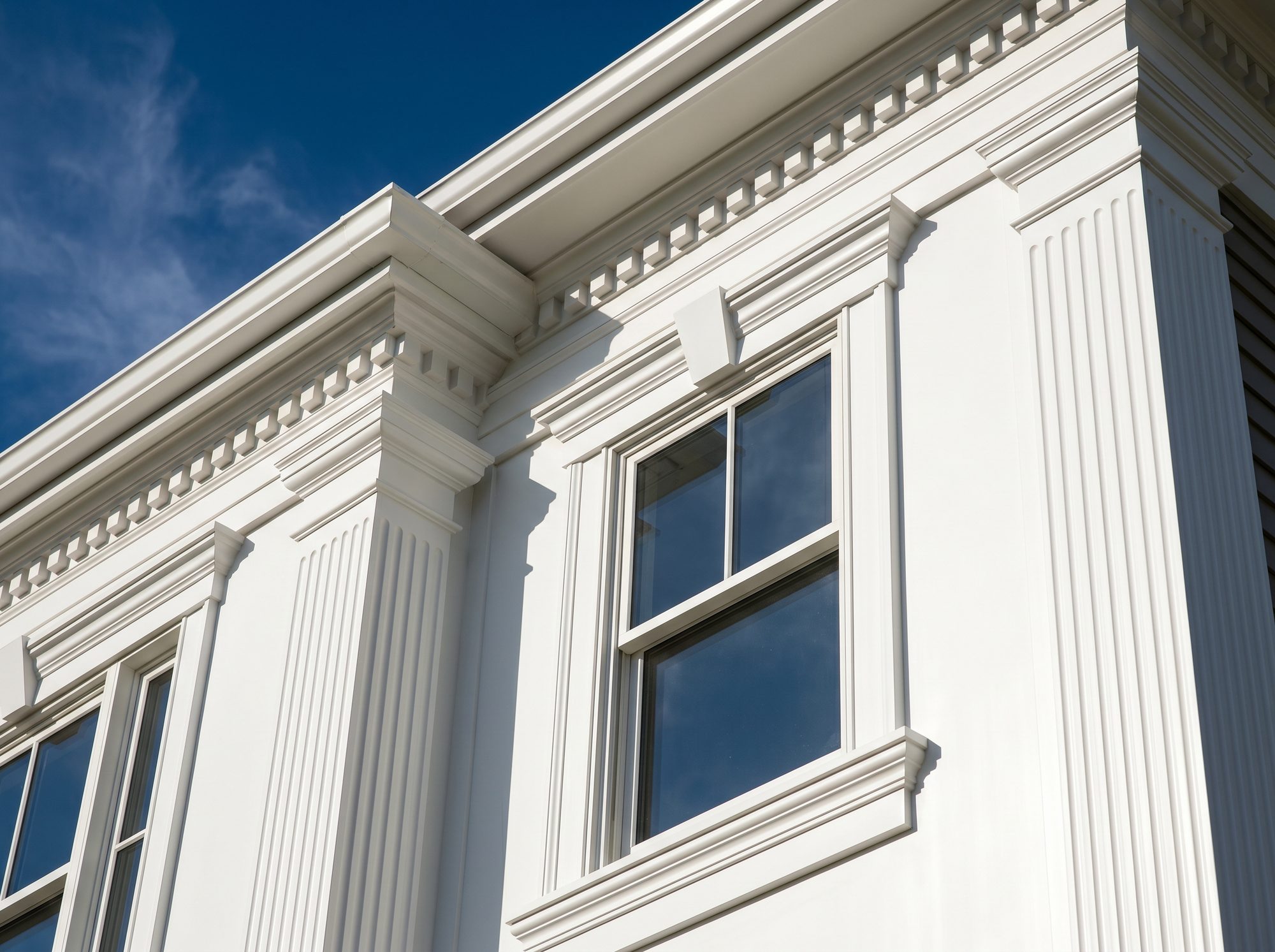
Drive any neighborhood older than thirty years and look at the trim. The crown line above a porch. The brick mould around a front door. The sill under a kitchen window. On a lot of houses, those pieces are quietly rotting from the inside, and the homeowner has no idea until a finger goes through the paint.
PVC mouldings don't do that. They don't drink water, so they can't rot. That single sentence is the entire reason architectural PVC moulding exists, and it changes how a house ages. This is the explainer we wish every spec writer, painter, and homeowner had read before the last wood replacement job they paid for.
Why wood mouldings rot in the first place
Wood trim fails because wood is a sponge with a paint job. Even kiln-dried, even primed, even back-primed, every cut end and every fastener hole is a straw. Water gets in. The paint film slows it down, but it doesn't stop it. Once moisture is behind the film, three things start happening at once:
- Fungi feed on the cellulose. Wood rot is a biological process. Spores are everywhere. They just need food and moisture.
- Freeze-thaw cracks the wood. Water expands when it freezes. Every winter widens the gap between the paint and the wood.
- Insects find the soft spot. Carpenter ants and termites don't make rot, they exploit it. Wet wood is easy wood.
The worst offenders are the parts of the house that get wet on purpose: brick mould around exterior doors, sills under windows that catch every storm, frieze and crown that sit just below a problem gutter, and water table that lives where siding meets foundation. These are the pieces that get replaced first, often by the second or third owner.
What cellular PVC actually is
American Pro mouldings are extruded from cellular PVC. The "cellular" part matters. The material is a closed-cell synthetic, foamed during extrusion so the inside is a dense network of tiny sealed pockets, not a single solid block. The result has a few useful properties at once:
- It machines and paints like premium wood. You can rip it, miter it, route it, sand it, and finish it with the same tools and the same habits.
- It is non-organic. No cellulose, no lignin, nothing for a fungus or termite to feed on.
- It does not absorb water. Water cannot wick into the cell structure the way it wicks into end-grain wood.
- It is dimensionally stable. It does not swell when wet, shrink when dry, or crack with the seasons.
Put the four properties together and you get the headline. A PVC moulding that is properly fastened and detailed will outlast the wood substrate behind it. The trim becomes the long-life part of the assembly, not the disposable part.
Wood rots because it eats. PVC doesn't eat.
The full American Pro moulding line, in plain English
The catalog is broader than most homeowners realize. Anywhere a house has a wood profile, there is a PVC version that drops in. Quick tour:
- Crown moulding. Five sizes from 2 3/4 inch up to 8 inch. Runs interior and exterior. The 8 inch and 5 1/4 inch profiles are popular on porch ceilings and historic restorations.
- Brick mould. The trim around an exterior door or window where it meets siding or masonry. The single highest-failure wood profile on most houses. PVC brick mould is the obvious upgrade.
- Sills, sill nose, and heavy sill. The horizontal piece under a window. Always wet, always the first to go in wood. PVC is the spec.
- Casing. Door and window casing in interior or exterior runs. Paint it once and forget it.
- Water table. Where the siding meets the foundation. Splash zone, ground contact, sprinkler zone. A wood water table is a guarantee of future work. A PVC one is not.
- Base cap, bed mould, cove, scotia cove, rake mould, drip cap, back band, quarter round, bead cap. The supporting cast that finishes a real trim package.
- Balluster stock. For railings that need the rot resistance of PVC and the look of a turned wood spindle.
All of it is extruded on our lines in Linden, New Jersey. If a job needs a profile that isn't in the standard catalog, our Special catalog covers historic and custom geometries, and we cut tooling in-house when a repeat job justifies it.
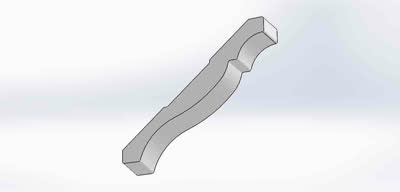
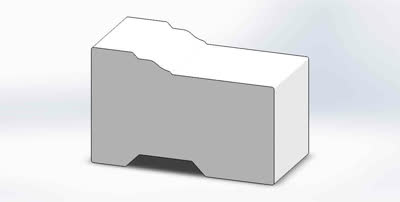
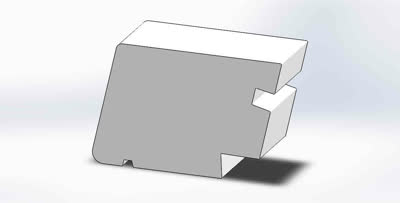
What it looks like up close
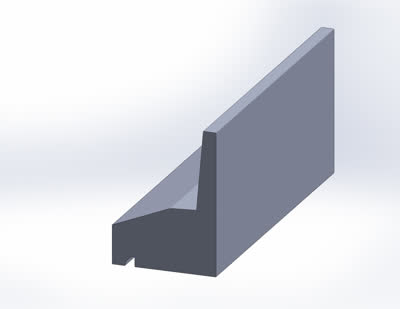
What "won't rot" buys the homeowner
Marketing copy says "lifetime trim." Here is what that means in real terms, the next time you walk the property.
- The brick mould around the front door stops being a recurring repair. Carpenters don't have to keep coming back to scarf in new pieces.
- The sill under the kitchen window stops staining the wall below. Water still hits it. It just doesn't go anywhere.
- The crown line on the porch stops sagging. No spongy spots. No paint flaking off in sheets after a wet winter.
- The water table can sit in wet mulch and grass. Ground contact is no longer a problem.
- The painter's job gets cheaper. When the substrate isn't moving, the paint film lasts much longer. Most owners report doubling their repaint cycle on PVC trim runs.
The other quiet win is resale. Inspectors flag rotted trim on almost every older home report. A house with PVC brick mould, sills, and water table doesn't get flagged for those line items, ever.
How to install PVC moulding the right way
PVC is forgiving, but it is not wood. A couple of habit changes make the install bulletproof.
- Fastening. Stainless trim screws or hot-dipped galvanized finish nails. Never bright steel, which can bleed through paint.
- Glue scarf joints. A bead of PVC cement at every long run scarf joint chemically welds the two pieces. The joint disappears under paint and never opens.
- Allow for thermal movement. Cellular PVC moves with temperature more than wood. On long runs over twenty feet, fasten in the center and let the ends float.
- Light colors only on exterior, if painted. White and light pastels hold up best. Dark paint absorbs heat and increases the thermal cycle. If a dark color is required, ask us for the heat-stable formulation.
- Use 100 percent acrylic exterior paint. No oil-based primer required. The PVC is the primer.
- Caulk the right gaps. Standard urethane or hybrid exterior sealants work. Skip the latex caulk on high-movement joints.
What PVC moulding is not
We are careful with the rot-proof line because we don't want to overclaim. Two honest clarifications worth making:
PVC mouldings are not structural. They are trim. The framing, sheathing, and substrate they ride on still need to be detailed correctly. PVC trim hides nothing. If a window head is leaking, water will still get behind the wall. The trim just doesn't get destroyed in the process.
PVC is not the same as composite. Cellular PVC is a single, closed-cell synthetic. Composite mixes wood fiber with plastic, which reintroduces the very thing PVC is solving for. American Pro mouldings are 100 percent cellular PVC. No wood content.
The shorter version
Wood mouldings rot because they drink. PVC mouldings don't drink. Spec PVC anywhere the trim is going to see weather, ground contact, splash, or chronic moisture, and you stop paying for the same repair twice. American Pro extrudes the full line, including crowns in five sizes, brick mould, sills, casings, water table, and the historic profiles that are hard to find anywhere else, in Linden, New Jersey, on tooling we cut ourselves.