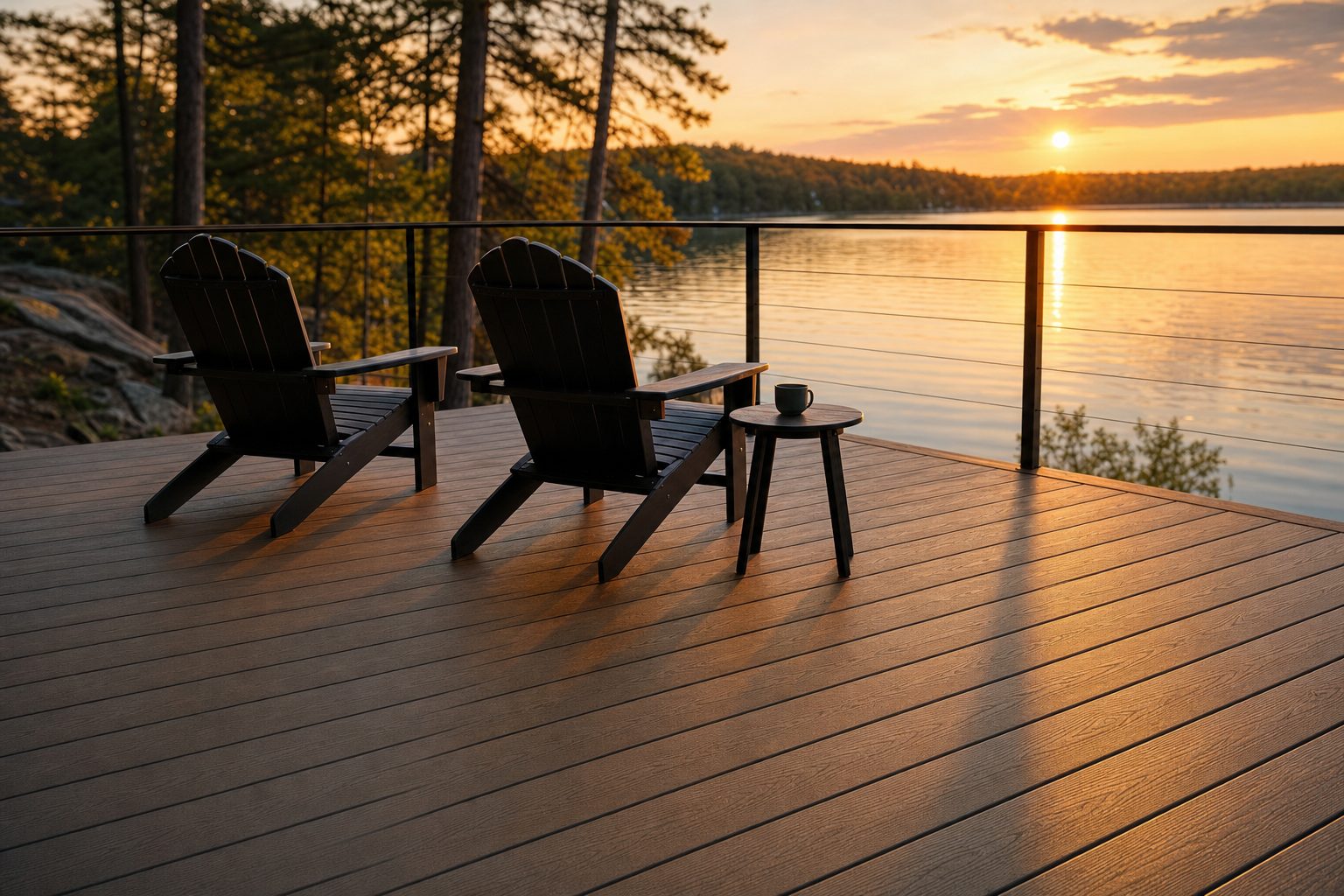
The old deck was doing what every wood deck does at year fifteen. Graying at the edges, cupping a little near the water, and giving up a splinter every time someone crossed it barefoot on the way to the lake. It had a good view and a bad floor. The goal for the rebuild was simple to say and harder to do. Keep the view. Fix the floor. And make it a surface nobody has to think about again.
The homeowners picked TrueGrain Deck in Aged Oak, fastened with InvisiClip, so the finished floor shows the wood grain and the water, and nothing else.
Why Aged Oak
Color on a lake is a lighting decision as much as a taste one. The site faces west, so the deck gets full afternoon sun and then a long golden hour off the water. Very dark boards would have looked heavy in that light, and they run hotter underfoot in July. Aged Oak lands in the middle. A warm, weathered brown with real grain movement, so it reads natural against pine and stone without going orange.
TrueGrain Deck earns that look honestly. It is a five-layer RENOLIT PMMA film over a proprietary ASA capstock over a cellular PVC core, which is why the grain has depth instead of a printed-on repeat. If you want the full construction story, we wrote it up in Inside TrueGrain Deck.
The best compliment a new deck can get is that it looks like it was always there.
The part you do not see
The detail that makes this deck feel calm is the one you cannot point to. There are no screws on the surface. The boards were set with InvisiClip, our hidden fastener system built on the proven GRAD® platform. POM clips ride on aluminum rails, the grooved boards drop in from above, and the fasteners disappear under the deck line.
What that buys you on a lakeside deck, specifically:
- A clean sightline to the water. No rows of screw heads breaking up the floor between you and the lake.
- Nothing to catch a bare foot. No proud screws, no counterbored plugs working loose over the seasons.
- Consistent gaps. The rail system sets spacing for you, so the reveal between boards stays even the length of the deck.
- Boards that can move. The clips let the deck expand and contract with lake-country temperature swings without fighting the fasteners.
The details that finish it
A deck is more than its field boards. Two choices did the quiet work here. First, a low black cable railing, so the guard does its job without stealing the view. Second, a picture-frame border in the same Aged Oak, which hides the board ends and gives the whole floor a finished edge instead of a cut-off one. Small moves, but they are the difference between a deck that looks built and a deck that looks designed.
And because the whole floor is cellular PVC, none of it is on a maintenance clock. No sanding, no sealing, no annual stain. A rinse and the occasional soapy scrub is the entire care routine. On a house you drive to on weekends, that is the actual luxury.
What we would tell the next owner
If you are staring at a tired wood deck with a view worth keeping, the playbook is not complicated:
- Pick a mid-tone board that flatters your light rather than fighting it. Aged Oak, New England Birch, and Coastal Driftwood all photograph well on the water.
- Hide the fasteners. A clean surface is the single biggest visual upgrade, and it is the one people notice without knowing why.
- Frame the edges and choose a railing that gets out of the way.
- Order full-size samples and set them on the actual deck at the actual time of day you use it. Color decisions made at a desk rarely survive the golden hour.
The floor should be the quietest thing on a lakeside deck. Get it right and the view does all the talking.