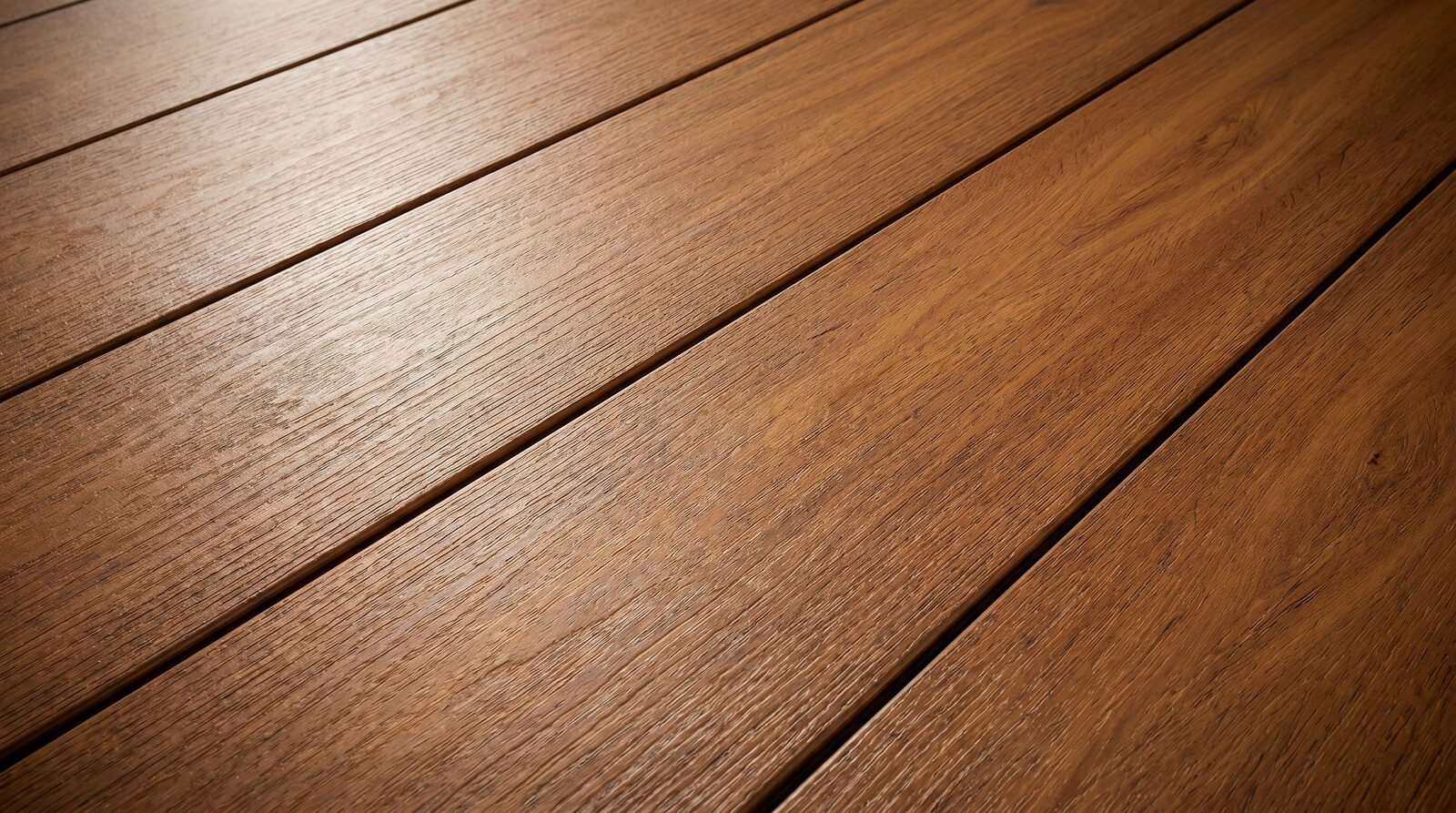
TrueGrain Deck™ is the flagship board in the American Pro line, and the only cellular PVC decking on the market that combines a Patwin-formulated proprietary ASA capstock with a permanently laminated five-layer PMMA wear film supplied by RENOLIT. Every word in that sentence matters. This post is the long-form version of the spec sheet, written for the people who actually want to know what is under the surface of the board.
There are three structural elements: the laminated wear film on top, the ASA capstock underneath the film, and the cellular PVC core that gives the board its shape and weight. The film is RENOLIT. The cap and core are Patwin. The whole board is made in Linden, New Jersey on extrusion lines we own and operate.
The wear film. Five layers, one job.
The decorative surface on TrueGrain Deck is not a printed cap and it is not a paint finish. It is a five-layer PMMA laminate manufactured by RENOLIT, a German polymer film specialist whose exterior foils are specified on building envelopes worldwide. The film arrives at our plant on the roll, pre-engineered, and is permanently bonded to the capped PVC substrate during extrusion.
The five layers, from the boot of your shoe down to the board:
- Highly scratch-resistant top layer. The face of the film. This is the layer your patio chair drags across, the layer the snow shovel hits, the layer that has to look the same in year fifteen as it does on installation day.
- Wear-resistant UV-protection layer. A dedicated layer whose job is to absorb the ultraviolet portion of sunlight before it reaches the pigment underneath. UV is what fades a deck. This layer takes the hit so the color does not.
- Printing ink. The variegated wood grain you see on every TrueGrain color is printed at this depth in the stack, sandwiched between two clear protective layers. It is not on top, where it could be scuffed. It is not painted onto the cap, where it could chalk. It is locked between the UV layer above and the pigmented PMMA base below.
- Pigmented PMMA base layer with SST. An acrylic base coat carrying RENOLIT's Solar Shield Technology. SST reflects the near-infrared portion of the solar spectrum, which is the part of sunlight that actually heats a surface. This is the chemistry behind the cool-underfoot behavior the board is known for, and it works regardless of board color.
- Primer. An engineered tie-coat on the underside of the film stack. It is a chemical handshake between the PMMA above and the ASA capstock below. The bond is permanent, not surface-applied, which is why the laminate cannot peel or delaminate at the edge.
PMMA is the acrylic chemistry the polymer industry reaches for when the requirement is long-term outdoor color stability with high optical clarity. It is the same family of chemistry used on the high-end automotive exterior films and architectural cladding panels you have driven past for years without noticing. It is specified for this application because it does not yellow, chalk, or haze under UV the way lower-cost chemistries do.
The grain is not on the board. The grain is in the board.
The capstock. Patwin proprietary ASA.
Underneath the RENOLIT film is the capstock, a Patwin-formulated proprietary ASA that we compound and co-extrude in-house. ASA stands for acrylonitrile styrene acrylate. It is the chemistry the polymer industry specifies for long-term outdoor color and weather performance: better UV stability than ABS, better impact than straight acrylic, and a thermal expansion profile that matches well with a PVC core.
On TrueGrain Deck, the ASA capstock seals the board on all four sides. That four-sided capping is what makes the difference between a board that holds up at the cut end and a board that does not. Field-cut ends are sealed in the extrusion, not in the install. The same capstock chemistry sits on the underside of the board, which means a board that gets flipped during installation, or that sits with its underside exposed on a porch or shaded deck, performs exactly the way the top performs.
We formulate the ASA ourselves rather than buy a generic capping material. The recipe is tuned to two boundaries at once: the chemical handshake with the RENOLIT primer above, and the bond with the cellular PVC core below. Both interfaces have to be permanent or the system does not work.
The core. Cellular PVC, 30% in-house regrind.
The body of the board is a cellular PVC core. Cellular means the compound is chemically foamed during extrusion so the interior of the board is a closed-cell structure rather than a solid mass. The result is a board that holds fasteners like a solid, weighs less than a solid, and stays dimensionally stable through freeze and thaw cycles because there are no open channels for water to enter and expand.
The cellular PVC compound on every TrueGrain board contains 30% in-house regrind: trim, edge skive, and off-spec material that was extruded in our own facility, ground in our own grinder, and fed back into our own line. This is closed-loop, single-facility material. It is not post-consumer commodity regrind purchased on the open market with unknown provenance. We know what is in it because we made it.
The same regrind ratio runs across all six TrueGrain colors, so cell density, board weight, and fastener pull-out behavior are constant whether you spec New England Birch or Tropical Walnut. The decorative film on top changes. The engineering underneath does not.
Why these three layers, this way
Composite and PVC decking has split into two manufacturing strategies over the last decade. One strategy puts the decorative effect on the cap, either by printing directly onto the capstock or by embossing a grain pattern into the surface. The other strategy laminates a separate decorative film over the cap. Both can look good on day one. They behave differently in year ten.
Printed and embossed caps live and die with the cap itself. The pigment is unprotected at the surface, so UV and abrasion act directly on the look of the board. The grain is shallow because the cap is thin, so once the surface starts to wear the depth and warmth flatten out.
A laminated film is a different conversation. The decorative effect lives between two engineered protective layers, the UV layer above and the pigmented PMMA base below. The cap underneath is purely structural, so its only job is to seal the core and bond the film. Each material does one job, and the system performs longer because the loads are not stacked on one layer.
What this means on a finished deck
All of the above is chemistry. The reason any of it matters is what happens after the board leaves the truck.
- Cool underfoot through the warmest part of the afternoon. SST in the PMMA base reflects near-infrared, so the deck surface runs measurably cooler than a standard composite under direct sun. The effect is strongest in lighter colors and is present in every color in the line.
- The grain is the same depth at year ten as it is on installation day. The ink lives between two protective layers, not on top. Foot traffic does not erode the look.
- Cut ends, miters, and picture-frame edges look the same as the field. Four-sided ASA capping means there is no exposed core anywhere on the deck regardless of how you cut.
- Three profiles, one surface. TrueGrain ships in Solid Edge, Grooved Edge, and Grooved for InvisiClip™ profiles. Solid Edge fastens with screws and color-matched plugs. Grooved Edge takes standard hidden clips. Grooved for InvisiClip drops onto our InvisiClip™ hidden fastener rails, which were tested by Intertek under ICC-ES™ AC174 Section 4.1.4 to an average sustained uplift of 292 psf and an average pressure at failure of 306 psf.
- The same compound chemistry across all six colors. Spec by color, not by performance, because the engineering is constant.
Field specs at a glance
- Actual board dimensions: 1 inch by 5.5 inches.
- Standard lengths: 12, 16, and 20 feet.
- Recommended gap between boards: 3/16 inch.
- Joist spacing: 16 inches on center maximum for residential and commercial. 12 inches on center for heavy loads or angled installs.
- Colors: New England Birch, Coastal Driftwood, Aged Oak, Embered Taupe, Royal IPE, Tropical Walnut.
- Warranty: 25-year limited residential on the foil. Separate Patwin Plastics warranty on the capped cellular PVC board.
- Manufactured by: Patwin Plastics, 2300 E Linden Avenue, Linden, NJ 07036. Single facility, single supply chain.
The relationship behind the board
One question we get often: why a partnership with RENOLIT instead of a film source with a shorter name and a closer flight. The answer is that we treat the wear film the way an automotive OEM treats its exterior coating. It is the single most visible component of the finished product, it has to hold its color and depth for decades of exterior exposure, and it has to bond chemically with the substrate below it.
RENOLIT has been engineering exterior PMMA films for these applications for decades. Their SST acrylic technology, their primer chemistry, and their multi-layer print stack are the result of a polymer R&D program we are not interested in replicating in-house. We extrude the PVC. We compound the ASA. We laminate the RENOLIT film. Each company does what it does best, and the board benefits from both.
Where to see it
The fastest way to verify the construction is to put a real board in your hand. We mail free 6-inch and 12-inch samples in any of the six colors. The cut end on those samples shows the capped cellular PVC profile and the laminated film interface in person, which is the part of the board no rendering can ever show.
If you want to design with the board before you order, the TrueGrain 3D Deck Visualizer will let you mock up your deck in any TrueGrain color and estimate board count, joist count, and fastener count for the layout you choose. The laminate data sheet is the one-page spec for architects and specifiers.