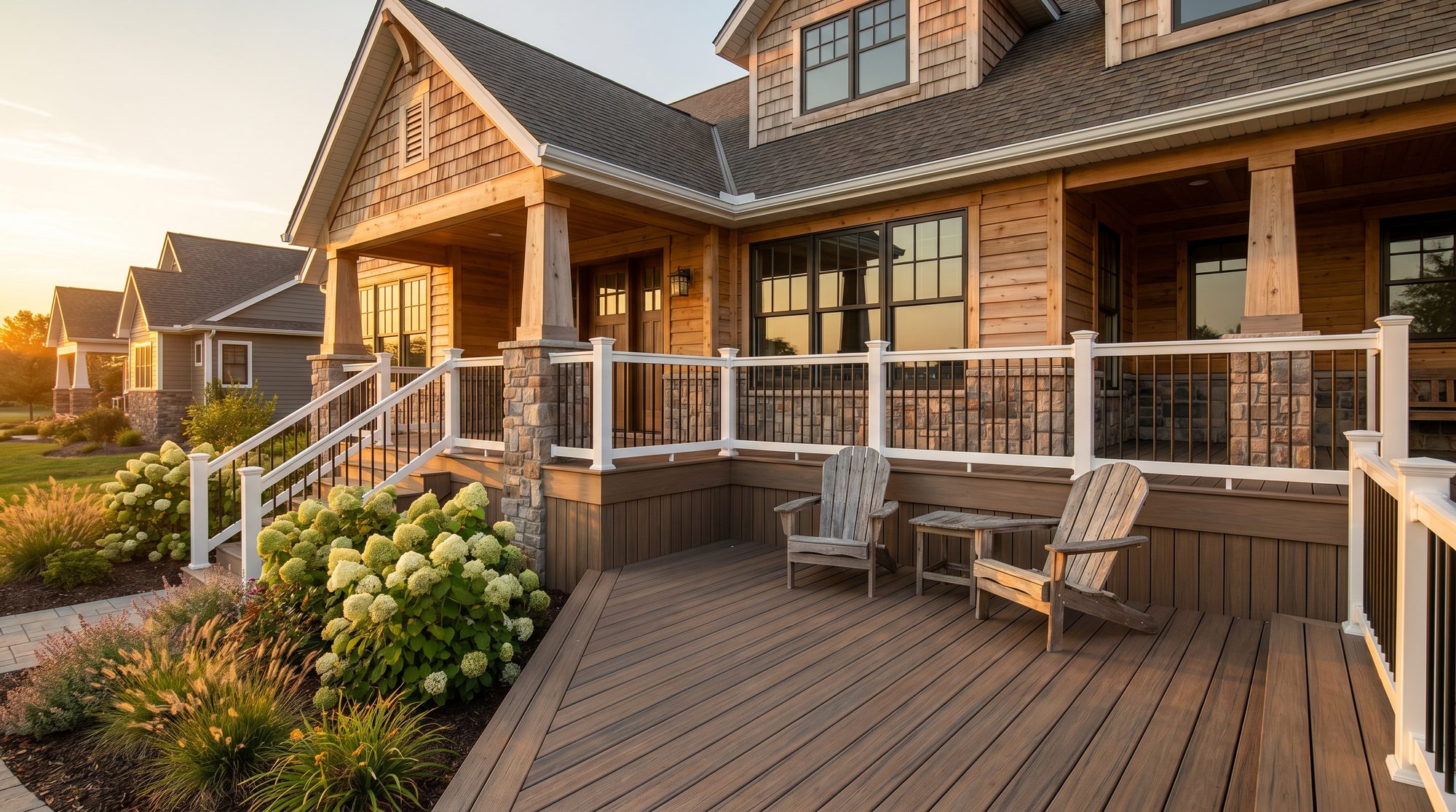
Mid-May is the week the calendar turns on a summer deck. Stock is moving, dealer lead times are tightening, and the contractors with finished decks on the Fourth of July are the ones placing orders right now. This is the short version of the conversation we have with every spec writer, GC, and homeowner who calls us in the spring.
Work through it once, on paper, before you order a board. Every step here saves a change order later.
1. Lock the footprint
Before colors, before fasteners, before the railing conversation, pin down the deck itself. Width, length, height off grade, number of levels, stair locations, and the tie-in to the house. A clean rectangle costs less and looks better than a clever shape that fights the joist layout.
Two numbers to settle now:
- Joist direction. Boards run perpendicular to joists. Decide which side of the deck the long board run faces, because that is the side people look at.
- Picture frame. A border board around the perimeter hides end cuts and makes a deck look finished. Add the width to the joist plan before you frame.
2. Choose the board, then the color
American Pro extrudes two cellular PVC deck boards on the same Linden, New Jersey line, and they spec differently.
- TrueGrain Deck™ is our wood-grain board. Embossed surface, capped color, six finishes from driftwood to walnut. The board you want when the deck has to read like wood from across the yard.
- Legacy PVC Decking is the solid-color, brushed-finish board that has been on commercial and rooftop jobs for years. Lower contrast, longer color palette, and a profile that takes paint if a project ever calls for it.
Order swatches before you order boards. Color reads differently in morning sun, under an awning, and against the siding you actually own. We mail real extruded sections, not printed cards.
3. Decide on hidden fasteners now
Fastener choice changes the board you order. American Pro decking comes in three profiles: Solid Edge for face screws and color-matched plugs, Grooved Edge for standard hidden clips, and Grooved for InvisiClip™ for our rail system. Both hidden options leave the face clean.
If you want the deck face uninterrupted, spec the Grooved for InvisiClip™ profile and our InvisiClip™ hidden fastener system at the same time you order the boards. The clip rides on an aluminum rail on top of every joist at 16 inches on center maximum. Independently tested by Intertek under ICC-ES™ AC174 for sustained uplift. The full data sheet and test report are on the InvisiClip page.
For the spots that have to be face-fastened anyway on a Legacy deck, stair treads, the perimeter board against the house, the last course at a wall, we spec the Starborn Pro Plug® System. It is a matched setup for our Legacy PVC Decking: a stepped bit that pre-drills and counterbores in one pass, Starborn stainless screws, and tapered cellular PVC plugs color-matched to the Legacy palette. Drive the screw, tap in a plug, sand flush. The face stays clean and the plug ages with the deck instead of bleaching out next to it.
Order the plugs to match the Legacy color you ordered. One bag covers roughly 100 square feet of perimeter and stair work. Put it on the same PO as the boards so it shows up on the same truck.
4. Run the numbers in the calculator
Once you have the footprint, the board, and the fastener path, run the math. Our deck estimator takes a square footage and a board length and returns board count, joist count at 16 inch on center, fastener count for InvisiClip™ or face screws, and a working material total. Use the output as a takeoff sheet to send to the dealer.
Two numbers worth checking by hand:
- Waste factor. Add 5 to 8 percent for a straight rectangular deck, 10 to 12 percent for a deck with diagonals or picture framing, 15 percent for stairs and complex angles.
- Board length. Long boards reduce butt joints but cost more per linear foot and ship slower. Match length to the actual run, not to the longest length on the price sheet.
5. Confirm joist spacing and substructure
Cellular PVC needs proper substructure or it will telegraph every flaw underneath. The short list:
- 16 inches on center maximum for residential perpendicular installs. Tighter for diagonal layouts and for any pattern that puts boards at an angle to the joists.
- Crowned joists installed crown up and planed flat across the top before the boards go down. A high spot under a PVC board reads in the finished deck.
- Joist tape on every joist to keep water and fasteners separated. Inexpensive, and the difference between a ten-year frame and a thirty-year frame.
- Ledger flashing in the right order. Cap flashing over the ledger, behind the siding, never on top of the deck board.
6. Place samples and confirm lead time
Samples are free, fast, and the cheapest insurance on the order. Request swatches of every color you are considering, a board cutoff in the profile you plan to install, and a section of InvisiClip™ rail with two clips if you are going hidden-fastener. Hand them to the homeowner, the framer, and the inspector before the truck rolls.
On lead time, call the dealer the same week. Stock varies by color and by region, and walnut and grey move first in May. If you are on the East Coast, our East Coast dealer list has the phone numbers for the two partners stocking American Pro right now.
7. Build a one-page spec for the file
Before the first delivery, write down what you actually ordered. One page, one job, one folder. Keep a copy on the truck.
The one-page job spec
- Deck dimensions, square footage, and number of levels.
- Board line and profile: TrueGrain Deck™ or Legacy, in Solid Edge, Grooved Edge, or Grooved for InvisiClip™.
- Color name and the swatch number from the sample you approved.
- Fastener system: InvisiClip™ on aluminum rail, grooved-edge hidden clips, or face fastening with the Starborn Pro Plug® System (stainless screws and color-matched PVC plugs).
- Joist spacing and substructure notes, including joist tape and flashing details.
- Board count, fastener count, waste factor, and total linear footage from the calculator.
- Dealer name, contact, PO number, and confirmed ship week.
- Install start date and target completion week.
The week that matters
A summer deck is a May decision. Spec it this week, sample it next week, order it the week after, and you are framing in June and grilling on it by the Fourth. Skip a step and the deck slides to September.
We are on the phone all week if you want to walk a job through with us.