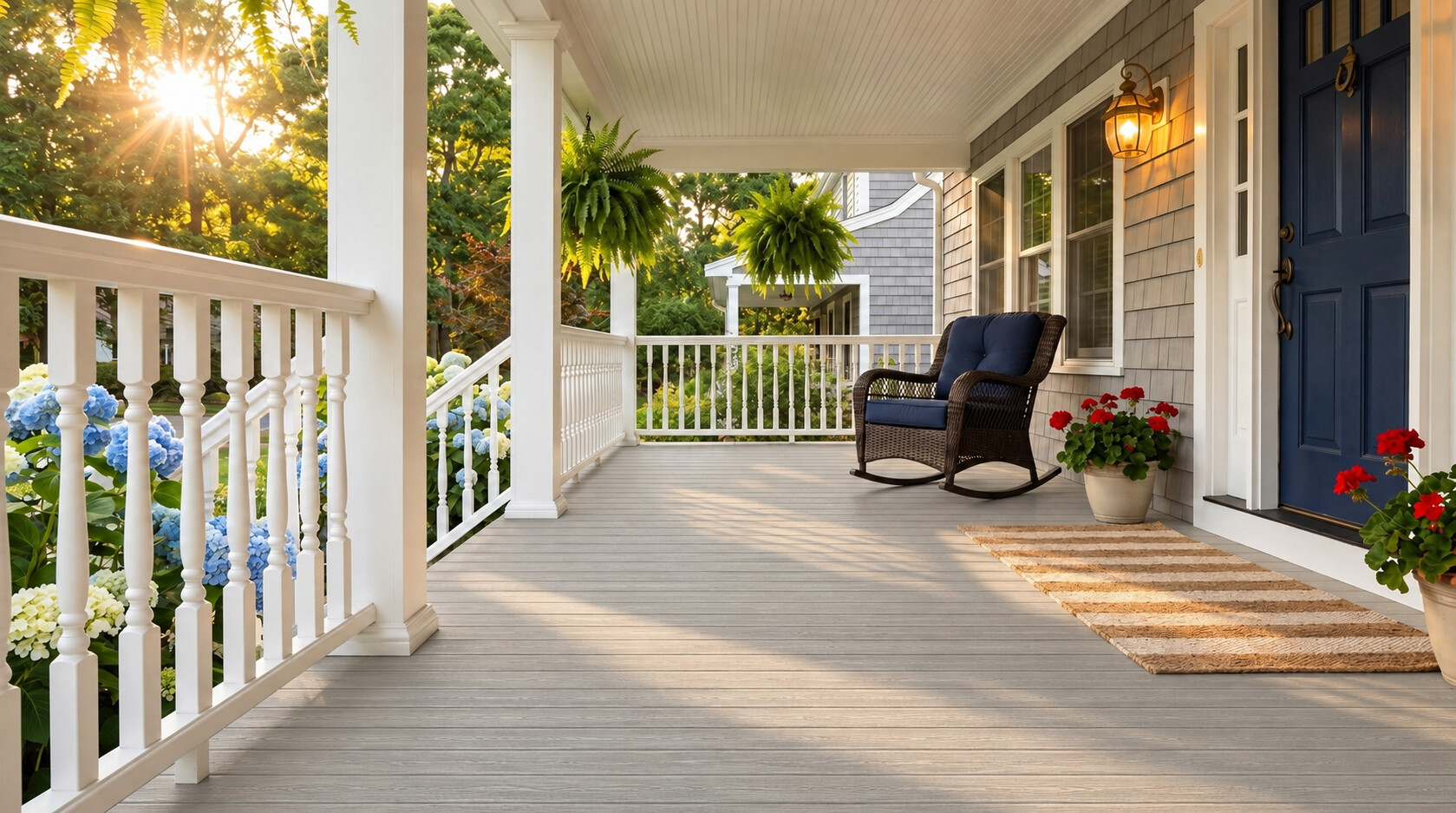
Most homeowners assume a porch floor is a drier job than a deck. It has a roof over it. It is not standing wide open to every storm the way a deck is. That assumption is backward. A covered porch floor sits directly under a roofline that catches rainwater and snowmelt and funnels it, at volume, onto the same few boards, over and over, for the life of the house. That is a harder water problem than an open deck ever sees, and it is why the material underfoot needs to be waterproof, not just water resistant.
Water resistant and waterproof are not the same claim
Water resistant means a material slows down moisture absorption for a while. Waterproof means the material has nothing in it for water to absorb in the first place. That difference sounds academic until you look at what is actually happening underneath a painted or sealed porch floor.
Sealed wood and capped wood plastic composite are both water resistant. A topical sealant, paint film, or polymer cap sits on the surface and pushes water off as long as that layer stays intact. Foot traffic, furniture legs, seasonal moisture cycling, and UV exposure all wear at that layer over years. Once it cracks, thins, or gets scratched through, the wood fiber underneath, whether it is solid lumber or the fiber blended into a composite core, starts absorbing water directly. From there it is only a matter of time before that moisture shows up as cupping, swelling, staining, or rot, usually starting exactly where you would expect: at the seams.
The tongue-and-groove seam is where it starts
Porch flooring is almost always installed tongue-and-groove, both for the tight, finished look and because it is how porch floors have been built for a century. That interlocking profile is also the part of the floor most exposed to trapped moisture. Water that lands on the surface works into the seam between boards and sits there, against two edges at once, far longer than it would sit on an open, gapped deck board that dries from both sides. On a water resistant material, that is a slow-motion failure point. The seam is usually the first place a wood or composite porch floor shows rot, swelling, or dark staining, because it is the last place to dry out between rains.
None of that changes how important the joist work underneath is. Whatever the floor is made of, it should sit on joists spaced to its rating (for American Pro, up to 12 inches on center for 3/4 inch boards and up to 16 inches for 1 inch nominal boards), sloped 1/4 inch per foot away from the structure so water actually sheds off the porch instead of pooling against the house. Good slope reduces how much water sits on the floor. It does not change what happens to that water once it reaches a seam in a material that can absorb it.
Why cellular PVC removes the problem instead of slowing it down
American Pro porch flooring is solid cellular PVC, not a wood core with a protective layer on top. There is no wood fiber anywhere in the board for water to get into, at the surface, at the tongue-and-groove seam, or at a fastener hole. Rain, standing snowmelt, humidity, and repeated wetting and drying cycles have nothing to act on, because the material itself does not absorb moisture. That is the actual distinction between water resistant and waterproof: one depends on a surface treatment holding up indefinitely, the other does not depend on a surface treatment at all.
It is also why cellular PVC does not need the maintenance a water resistant porch floor does. There is no sealant to reapply on a schedule and no paint film to watch for cracking. Routine cleaning with soap and water keeps the surface looking new, and because there is no exposed wood fiber, the floor will not rot, splinter, cup, or grey out as it ages.
What this means when you are comparing porch materials
If you are weighing pressure-treated wood, natural hardwood, wood plastic composite, and cellular PVC for a porch, waterproof versus water resistant is the question to ask before color or price. A roofline pushes more water at a porch floor over its lifetime than most people expect, and the tongue-and-groove seams that make a porch floor look finished are the same seams that will eventually fail on a material that only resists water instead of shrugging it off entirely. A floor that cannot absorb moisture in the first place does not have that failure point to manage.